
Government contractors often focus on billing formulas, revenue setup, and reporting outputs without realizing Project Account Group (PAG) structure helps drive those outcomes. PAG decisions can affect how costs are categorized, which then affects financial reporting, project reporting, billing, and revenue calculations. A well-designed PAG structure helps create consistency across projects, while a misaligned structure can lead to unexpected reporting results, additional reconciliation efforts, and unnecessary maintenance over time. In this article, we'll explore what PAGs are, why they matter, and how proper configuration can help support more reliable billing, revenue, and project reporting.
Why PAG Structure Matters More Than It May Seem
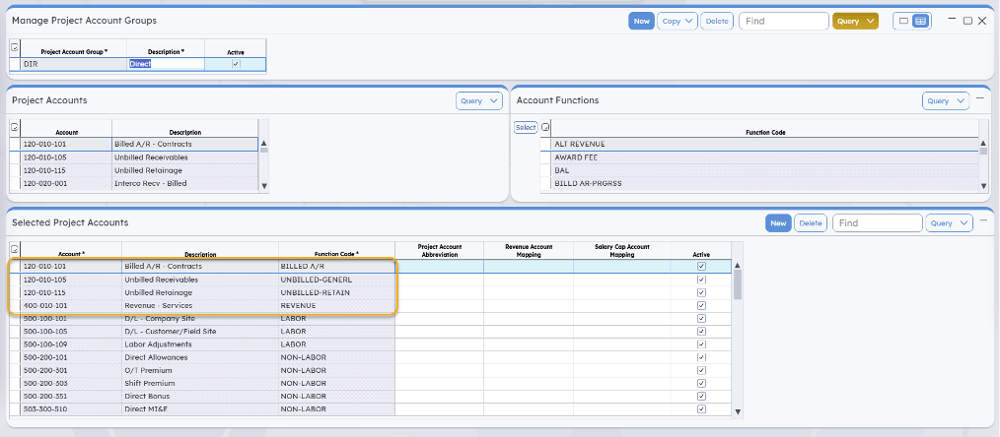
PAGs establish a group of general ledger (GL) accounts that can be used for transactional charges on a given project. Through account function codes, they also act as a mapping between revenue calculations, billing calculations, and project reporting. For additional background, read our overview of Project Account Groups in Deltek Costpoint, which explains their role in cost segregation, financial reporting, and auditability.
PAGs help determine how different types of costs are interpreted throughout the system. They provide the structure that allows Costpoint to consistently categorize labor, materials, indirect costs, unallowable costs, and other transactions as they move through billing, revenue, and reporting processes. Because of this, PAGs are more than a project setup task. They are an important part of the overall financial design of your Costpoint environment.
How PAG Design Influences Revenue and Billing
Revenue and billing calculations often receive the most attention during implementation and system reviews. However, those calculations depend on the underlying PAG structure to interpret project costs correctly.
Revenue
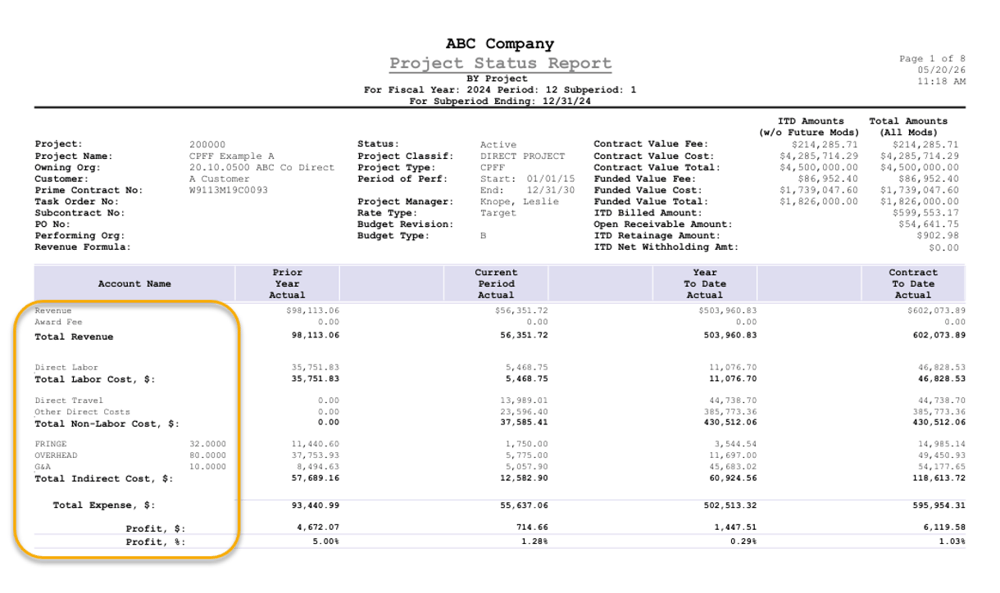
PAG configuration helps determine which costs are included in revenue calculations, how indirect costs are treated, what makes up the revenue base, and the GL account where revenue is posted.
When PAG mappings don't align with the organization's intended reporting structure, revenue calculations may still process successfully but the results may not reflect the business expectations behind the contract. This often leads to additional review, analysis, and reconciliation before revenue can be finalized.
Billing
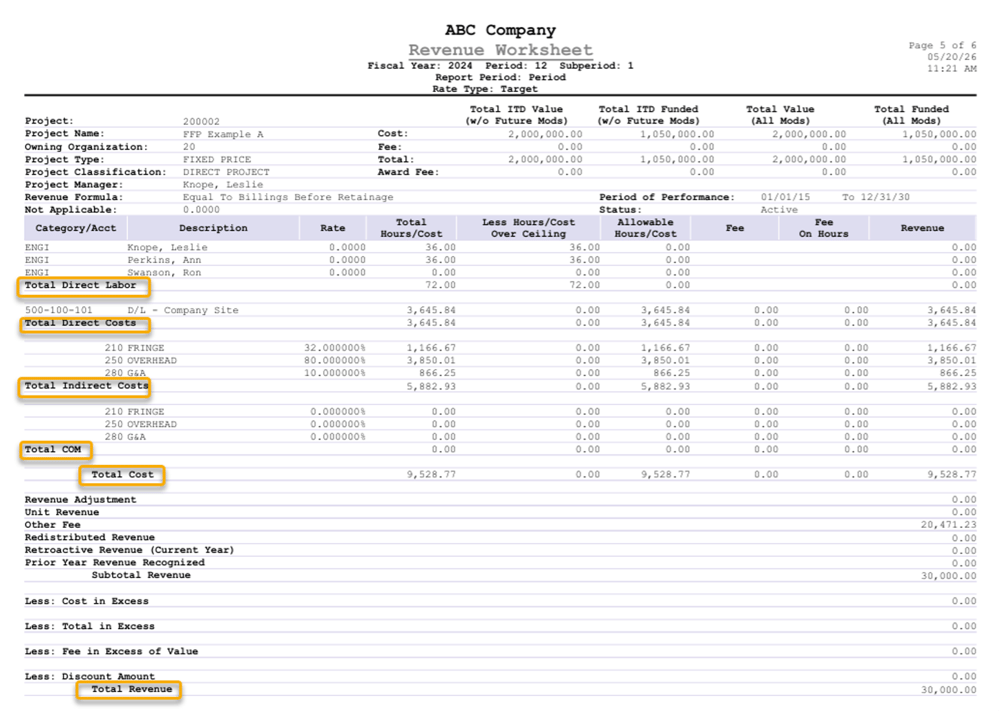
The same concept applies to billing. PAGs help distinguish billable and non-billable costs while supporting how labor, materials, indirect costs, and fees are treated during invoice calculation. PAG mappings also identify the GL accounts used for billed and unbilled accounts receivable. For time and materials (T&M) and cost plus contracts in particular, this structure plays an important role in producing accurate invoices.
If the PAG configuration doesn't align with contract requirements, organizations may find themselves investigating why expected costs weren't billed, why costs that should have been excluded appeared on an invoice, or why fee calculations require additional review. Although the system may process transactions exactly as configured, the results may not match the intended contractual outcome.
How PAG Decisions Can Affect Reporting Long After Transactions Are Posted
Project reporting is how government contractors monitor project performance, evaluate profitability, and understand how projects are progressing financially. PAGs help determine how costs roll into reporting categories such as labor, other direct costs (ODCs), indirect costs, revenue, and profit. Those classifications influence many of the reports project managers, finance teams, and leadership rely on to make decisions.
Because account function codes are recorded in project ledger history during processing, changes made later should be evaluated carefully. Modifying established PAG structures without understanding the downstream impacts can create historical inconsistencies and increase the effort required to reconcile reporting through the project’s life cycle.
Treat PAG Changes as Governance Decisions
As projects accumulate history, PAG configuration becomes part of the government contractor's long-term financial data structure. That doesn't mean changes can never be made, but they should be approached thoughtfully. Before modifying an existing PAG structure, government contractors should consider how the change could affect project reporting, revenue, billing, historical consistency, and reconciliation efforts. Depending on the change, corrective work may include reclassification entries, updates to project history, and additional reconciliation between the GL and Project Ledger. Evaluating these impacts before making configuration changes helps reduce surprises and supports more consistent financial reporting across the organization.
Building a Sustainable PAG Strategy
Rather than creating new PAGs for every unique situation, organizations often benefit from developing a standardized approach that supports their contract portfolio and reporting requirements. Taking a governance-focused approach helps reduce maintenance, improve consistency, and simplify future system administration.
An effective PAG strategy should:
- Align with contract types and reporting needs.
- Support consistent treatment of direct, indirect, allowable, and unallowable costs.
- Promote standardized configuration where appropriate.
- Be validated in a test environment before broad deployment to confirm billing, revenue, and reporting produce the expected business results.
- Be reviewed periodically to ensure the structure continues to support the organization's evolving business model.
Maintaining PAG Design as Business Needs Change
Project Account Groups may not receive the same attention as billing formulas or revenue calculations, but they provide the foundation those processes rely on. When designed carefully, PAGs help government contractors produce consistent billing, revenue, and project reporting while reducing unnecessary reconciliation. When the structure no longer aligns with business or contract requirements, the resulting inconsistencies can become increasingly difficult to manage over time.
Redstone Government Consulting assists government contractors with evaluating PAG structures, reviewing account function mappings, and investigating billing, revenue, and reporting discrepancies. Our Costpoint consultants assist with assessing proposed changes, reconciling affected project and GL balances, and testing expected results before changes are applied to live operations. We also provide training and documented procedures to support consistent use and ongoing maintenance.

 Heather is a Senior Managing Consultant with Redstone Government Consulting, Inc. Her areas of expertise include supporting government contractors in the implementation and operation of Costpoint, assisting with employee training, and providing outsourced accounting services, including program control deliverables, financial analysis, forecasting, general ledger, unbilled analysis, reconciliation, accounts payable, accounts receivable, payroll, and payroll taxes. Heather specializes in best accounting practices, from setup and training to monthly processing. Heather has over 19 years of experience in government contracting, supporting a wide range of contract types and customers. Her areas of expertise include program control, financial analysis, forecasting, government cost accounting, and procurement. Heather’s hands-on technical experience in all aspects of the business department provides a unique set of expertise for our clients. Heather has led and participated in numerous Costpoint implementations and re-implementations for the Accounting, Projects, Subcontractor, and Planning modules. She has worked directly with our clients to design accounting systems that are meaningful and useful for each client. She provides training in these modules and has developed desktop procedures that allow for a quick and seamless transition and implementation of these modules. Her experience in utilizing and implementing Costpoint gives our clients a unique perspective on the best practices related to both implementation and government accounting procedures. Her knowledge and guidance of the setup and end-user experience helps to ensure our clients receive a fully configured system that not just meets their current needs but will also allow them room to grow within the Costpoint system in the future. Heather is also experienced in assisting clients with “day-to-day” accounting processes. She has experience with all the normal accounting processes, such as accounts payable, account receivable, journal entries, reconciliations, reporting, etc. She helps multiple clients to produce, review and submit all types of project billings, including experience with WAWF, NASA 533s and MORADO. She processes, reviews, and submits timekeeping, leave and payroll data for multiple clients on a regular basis. Heather’s knowledge and experience in all business departments provides an invaluable resource to our outsource clients.