
Timekeeping compliance is a combination of several critical components that involve everyone within an organization. Given the specific requirements for government contracts, it is crucial to develop a structure and process for timekeeping and compensation. Here are some considerations when reviewing your company’s timekeeping compliance:
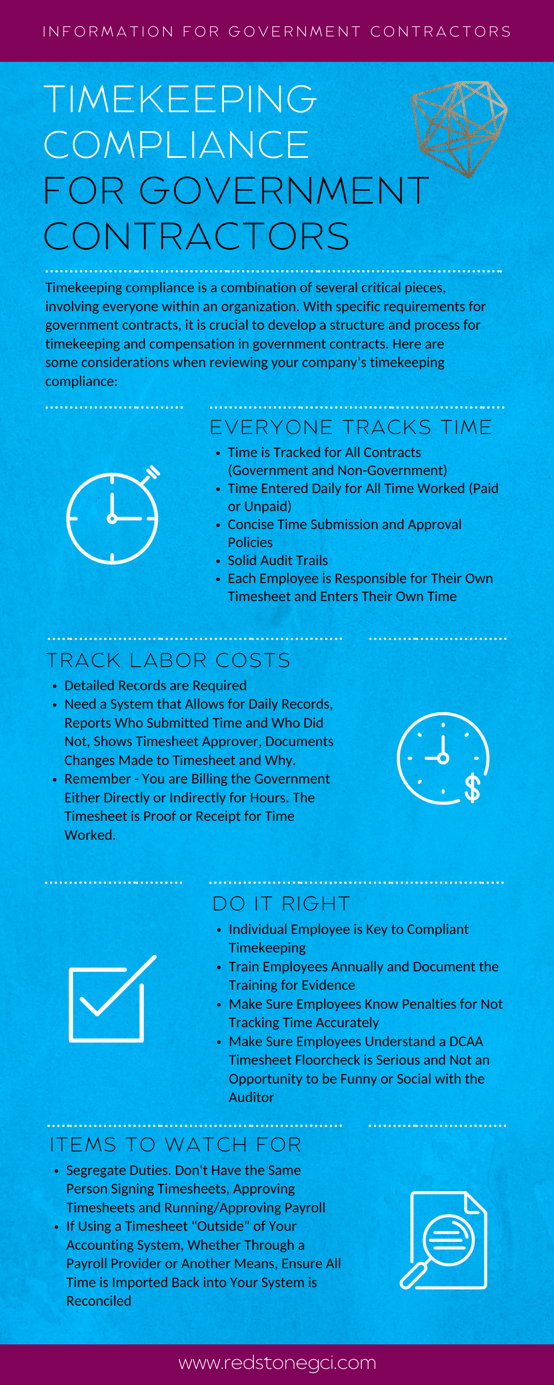
Everyone Tracks Time
A fundamental aspect of compliant timekeeping is that it applies to everyone, not just to those working on government contracts. Building consistency across your organization lays the foundation for audit readiness and strengthens accountability.
- All contracts included: Time must be tracked for both government and non-government work to maintain consistency and audit readiness.
- Daily entry required: Time should be entered each day for every hour worked, regardless of whether it is paid or unpaid.
- Policy clarity: Clear, documented policies for submitting and approving time entries help avoid confusion and noncompliance.
- Audit trail established: Systems must retain a visible and unalterable record of time entries and approvals for audit support.
- Individual responsibility: Each employee must personally complete and submit their own timesheet to preserve data integrity.
By adopting a consistent, policy-driven approach to timekeeping, your organization ensures auditability, accountability, and proper cost segregation. With this foundation established, you can focus on making sure your systems support accurate labor cost tracking.
Track Labor Costs
Labor costs are a significant component of government contract billing, and timekeeping records serve as the source documentation for those charges. Inaccurate or incomplete records can result in questioned costs and compliance issues. A strong system is essential for traceability and audit support.
- Maintain detailed records: Timekeeping must capture granular data that supports direct and indirect labor cost allocations.
- Use a compliant system: Your system should support daily entries, track submission status, document approvals, and log changes.
- Understand billing impact: Timesheets serve as proof of time worked and directly support billing charges to the government.
Accurate labor costs begin with reliable time data. If your systems and records fail to clearly support how hours are charged, you risk audit findings or disallowed costs. However, technology alone isn’t sufficient because people remain central to compliance.
Do It Right
Timekeeping systems are only as strong as the people using them. Your employees must not only understand how to use the system but also why their individual compliance matters. Training and accountability are non-negotiable in a government contracting environment.
- Emphasize the employee’s role: Each individual is the first line of defense in ensuring accurate and compliant timekeeping.
- Conduct regular training: Annual training helps ensure employees understand requirements and reinforces proper procedures.
- Communicate the consequences: Employees must be aware of the penalties for failing to track time accurately or on time.
- Prepare for audits: Ensure employees understand that DCAA timesheet floorchecks are formal reviews, not casual conversations.
While training is vital, fostering the right workplace culture is equally important. Employees are more likely to take timekeeping seriously when they understand its significance and the potential consequences. Even with excellent tools and training, compliance can easily fail if internal controls are neglected.
Items to Watch For
Even companies with good systems can fall short if internal controls are weak. Certain red flags, like shared responsibilities or disconnected systems, can expose your organization to risk. These are common pitfalls to avoid.
- Separate key duties: Avoid having the same person responsible for signing, approving, and processing timesheets and payroll.
- Reconcile external timesheets: If using an outside system, ensure time is fully imported and reconciled within your accounting platform.
Internal control weaknesses are among the most common issues cited in audits. A minor oversight, such as failing to reconcile external time data, can lead to greater compliance risks. Ongoing review of your processes is key to long-term success.
Final Considerations
Effective timekeeping is not just a system requirement; it is a cultural and operational priority for government contractors. From individual accountability to internal controls, each element plays a role in ensuring your timekeeping practices can withstand audit scrutiny. Building a program that combines policy, training, technology, and oversight ensures you’re not just compliant on paper, but in practice as well.
If your organization hasn’t reviewed its timekeeping processes recently, now is the time to do so. Redstone GCI supports contractors in assessing and strengthening their timekeeping and labor charging practices through specialized consulting, internal control evaluations, DCAA audit support, and training programs tailored to your systems and structure. Strengthening these areas helps reduce audit risk, improve cost accuracy, and demonstrate the internal discipline expected in the government contracting environment.

 As Director of Compliance Consulting at Redstone Government Consulting, Jonas Clem leads our compliance team in helping government contractors navigate the complexities of federal compliance requirements. With deep expertise in DFARS business systems, cost proposal compliance, and government audits, Jonas provides strategic guidance to our clients facing DCAA and DCMA audits, ensuring compliance at every stage, from pre-audit preparation to post-audit resolution. Jonas is a recognized expert in government property management and purchasing system compliance, having successfully implemented and refined these systems for contractors of all sizes—each passing rigorous government audits. He also delivers targeted training programs, equipping clients with the knowledge needed to maintain compliance with DFARS business systems, FAR 31 cost principles, indirect rate strategies, and cost proposal requirements. With over 20 years of experience in the government contracting industry, Jonas has held senior leadership roles spanning program finance, contracts, accounting, and operations. A significant portion of his career was spent with a small business contractor that expanded into a $100M+ large business prime contractor, where he progressed through leadership positions to ultimately serve as Business Operations Manager for the NASA and Army Programs Division. Additionally, he has served as a Controller for a large NASA prime contractor, strengthening his expertise in financial management, compliance, and audit readiness. Jonas' comprehensive, hands-on experience across the government contracting lifecycle, including DoD and NASA contracts, makes him an invaluable resource to our clients. His proven expertise spans proposal development and pricing, indirect rate structuring, and DCAA/DCMA audit readiness. With an unparalleled blend of accounting, contracts, operations, and regulatory knowledge, Jonas delivers practical, results-driven compliance strategies that help our clients mitigate risk and succeed in today's highly regulated environment.